Vivienne Ming: Build better people
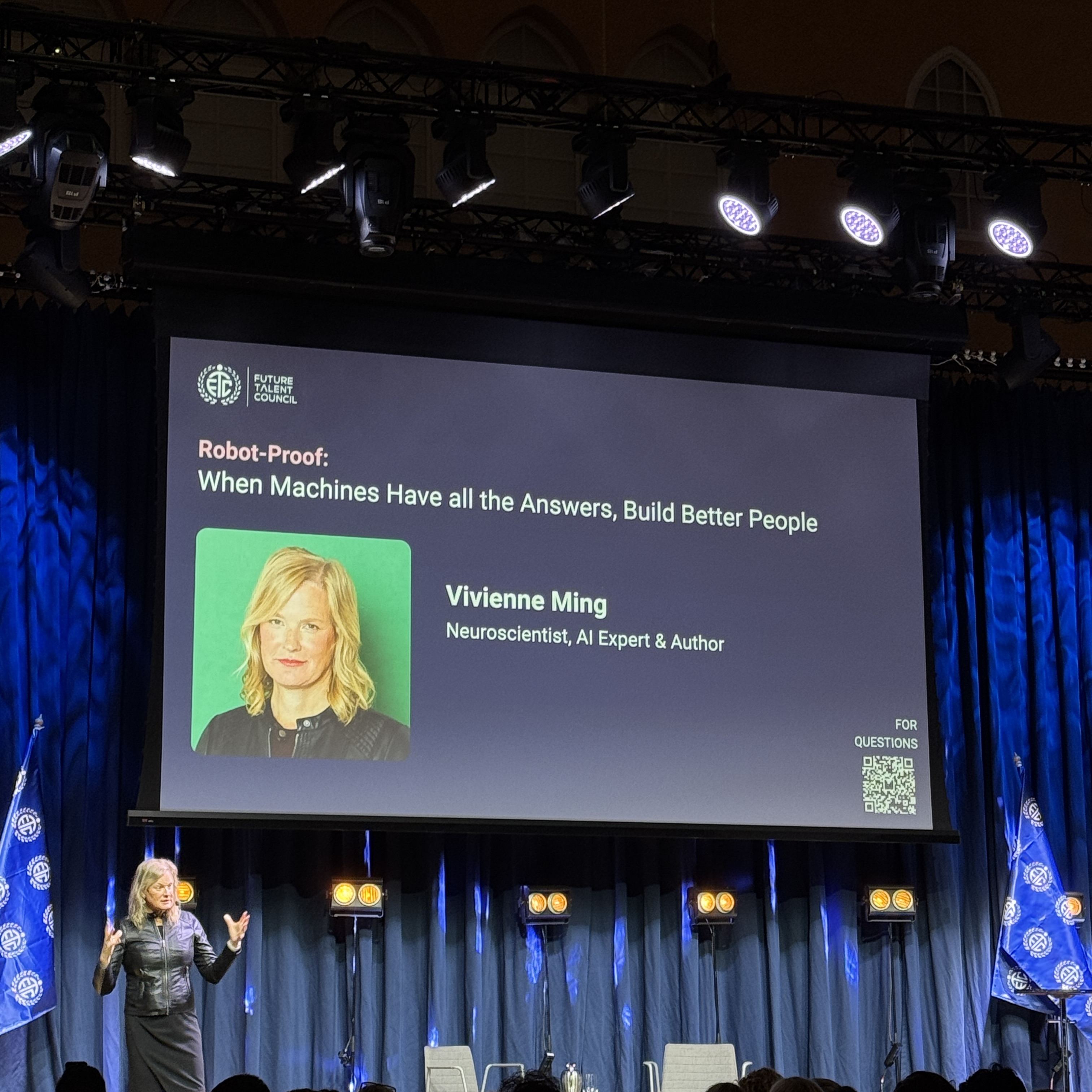
Most AI talks at a conference like this blur into the same slide deck. Faster, cheaper, smarter, here’s the roadmap. Vivienne Ming gave the opposite talk, and it was the best thing I saw all week.
A quick word on who she is, because it’s why I took every line seriously. Ming is a theoretical neuroscientist who has been building machine learning models for 30 years, long before “AI expert” showed up on every other LinkedIn profile. She’s a visiting scholar at UC Berkeley’s Redwood Center for Theoretical Neuroscience, co-founded the think tank Socos Labs, and runs a nonprofit called The Human Trust, where people bring her hard problems and, if she thinks her team can help, she funds the work and gives the results away. Along the way she has built models that predict human capability from data on tens of millions of professionals, and used AI to help treat diabetes and bipolar disorder, reunite refugee families, and teach autistic kids to read facial expressions. Her new book, Robot-Proof: When Machines Have All the Answers, Build Better People, came out this year, and the talk carried its title and its central question: what human qualities go up in value as machines get more capable?
The Sam Altman moment
Her starting point was a line Sam Altman gave to the US Congress. Imagine a free tutor for every kid. If you lean optimistic about AI, that sounds like a dream. Tutors are one of the strongest predictors we have of how a child turns out.
Then Ming, who has spent years researching education, dropped the hammer. There’s a rule in AI education that’s been replicated again and again: the moment the tutor gives the student the answer, the student stops learning. A free answer machine for every kid isn’t a tutor. It’s the opposite of one.
Here’s the version that landed for me as a founder. A junior employee with a copilot is the same thing as a student with a tutor that hands over answers. If the tool does the thinking, the person never learns the job.
She backed it with the research arc. Early studies showed junior employees getting a real boost from AI. The newer data tells a different story. The people genuinely pulling ahead are the experienced, highly skilled seniors, the ones who already know enough to direct the tool and check its work. The juniors are getting answers. They aren’t getting better.
We’re training worse computers
Ming’s bigger argument is about what we reward. For two hundred years, education has been built to do one thing well: take a question we already know the answer to, and prove on demand, with a pencil and a sheet of paper, that you can reproduce it. That exact skill is now free in everyone’s pocket. So what are we manufacturing? In her words, worse computers. A generation trained to do the one thing machines already do perfectly.
What goes up in value is what she calls foundational skills and meta-learning, which is just learning how to learn. Working memory. Curiosity. A sense of purpose. She is emphatic that none of this is soft, feel-good language. She’s a hard-numbers scientist, and when you put real measures on these traits, they predict how long you’ll live, how much you’ll earn, how many friends you’ll have, even your walking speed at 65. The name of the university on your resume does not, once you account for the foundations underneath it.
The experiment: automators, validators, and 95% of us
This is the part I keep coming back to. Ming wasn’t measuring how smart the AI is, or how smart the human is. She wanted to measure the pair, the human and the machine working together. She calls it hybrid intelligence.
She handed bright Berkeley students real prediction-market questions, the kind with actual money riding on them, like where the price of oil lands in six months. The students on their own were barely better than a coin flip. The worst AI model on its own beat the best human. Taken alone, that’s a grim result for team human.
The interesting part was how people used the tool. Two patterns covered almost everyone.
The automators, 60 to 70% of them, pasted the question into the chatbot and pasted the answer back out. They became, in her words, a very expensive copy. She had an EEG running, and the brain activity tied to genuine cognitive effort essentially switched off. One aside has stuck with me since: turn-by-turn navigation is already causally linked to weaker memory, and the jobs with the lowest rates of Alzheimer’s are the ones that make you think your way across a city, taxi and ambulance drivers, rather than the bus driver on a fixed route. Nobody on the Google Maps team set out to build a machine that thinks for your brain. It happened anyway.
The validators used the AI to confirm what they already believed. Tell me why I’m right. The models are glad to oblige, because they’re tuned to please you. This group performed worse than the AI would have on its own. The automators at least didn’t make things worse. The validators actively did.
Add those two groups together and you’ve described 95% of everyone she tested. That’s the number that should keep you up at night. Almost everyone, handed the most powerful tool of our lifetime, used it to think less.
Socrates
So she built the opposite. A model called Socrates that never gives you the answer. It asks the sharper question and hands you context, nothing more. On every standard benchmark, Socrates scores zero. It flat out fails the task. Students hated using it.
It also produced the highest hybrid intelligence of any model she tested, and a fifth of the people who used it shifted into actually thinking for themselves. Her point cuts at the whole industry: the benchmarks everyone races to win don’t predict any of the things we claim to care about. They don’t tell you whether the tool made the person better. The models are built to give us what we want. Almost none are built to give us what would make us better.
The choice
Ming is not anti-AI. She’s spent 30 years on it and clearly loves the work. Her warning is about lazy defaults. “Human in the loop” treated as a box to tick is theater, and she told a great story about a union town where one person digs the hole and a dozen others stand around watching. An AI tuned purely for economic output, with a human bolted on for show, is a dead end. The real work is figuring out how the person and the machine come out better together than either was alone, and almost nobody is building for that. Her nonprofit is now building the first benchmark that measures it, scored on things like the lifespan, the income, and the number of friends of the people who use a given model.
Her close was simple. None of this is inevitable. It’s a choice. And it isn’t Sam’s or Dario’s or Elon’s to make on our behalf. It’s ours. Choose the future, and start now.
Why it stuck with me
You can probably guess why this one hit home. The whole reason Opmore exists is the gap between what a founder knows and what everyone, and everything, that comes after them can actually reach. Ming’s research points at the same danger from the other side. The risk isn’t the machine. It’s handing the machine your thinking and getting a cheaper copy of yourself back. The companies that win the next decade won’t be the ones with the best model, because everyone has the same model. They’ll be the ones who captured the judgment, the context, and the foundations a model can’t pick up on its own. Build better people first. Then give them better machines.